BIG NEWS: Gravel NY is going ‘official’ for 2025!

Gravel NY is now a Bicycle Club recognized by the League of American Bicyclists!  We have obtained liability insurance under the League’s provider.  Members and first-time guests are covered under this insurance during GrNY club rides.

This means that you must fill out a digital liability waiver form before your first ride of 2025 – it takes only seconds to complete.   Click here to sign the Digital Waiver

Please see Guidelines for more information about other updates, including how club membership will work for 2025.

How to Contribute to GrNY

GrNY will remain free to join and free to ride, so just come out and ride. That said, contributions to help cover expenses are always appreciated. 

  • Suggested contribution of $10 per member for the entire year.  This covers the increase in our insurance for each new member.  Any contributions above $10 will help cover other club expenses. 
  • We have set up a club bank account to handle expenses and contributions.
  • Venmo: @GravelNY.  Verification number: 0812.  You’ll see Steve’s name associated with the account. 
  • Zelle: The Zelle ID is gravelny@gmail.com. You’ll see Steve’s name associated with the account. Reach out to Steve (track.smart@gmail.com) if you’d prefer to use a Zelle QR code and he can email you the QR code.

For those who haven’t heard… Gravel NY is now a Bicycle Club recognized by the League of American Bicyclists!  We have obtained liability insurance under the League’s provider.  In addition to $1M/$5M of liability coverage, our insurance provides $10k/rider of Excess Accident Medical Coverage.  The latter covers out-of-pocket medical expenses that are not covered by existing medical insurance.  Members and first-time invited guests are covered under this insurance during GrNY club rides.

E-bikes

Generally speaking, GrNY is a club for people who enjoy mixed terrain riding on manual bicycles. Exceptions to the manual bicycle rule: Pedal-assist (no throttle) e-bike riders who join our shortest distance (most casual pace group) and ride in a way that is respectful to that group.  In general, e-bike riders should stay in the middle (or back half) of the pack, not in the front. Moving towards the front of the group (especially on climbs) risks blowing up the expected pace of the ride.  E-bike riders who ride off the front of the group, ride in an unpredictable manner, or otherwise do not naturally mesh with the pace and skill of the group may be asked to either, a) ride off the back of the group, or b) to leave the group and ride solo.

GrNY Guidelines for E-bikes

1)           It must be a state legal, pedal-assisted e-bike (no throttles allowed).  This is required for our club insurance.  Our rides are frequently in NY, NJ, and CT and may cross the borders of more than one state during a single ride.

2)           E-bike riders should stay out of the medium or faster pace groups and instead ride with the slowest (and most casual) pace group. 

3)           In general, e-bike riders should stay in the middle (or back half) of the group, not in the front. Moving towards the front of the group (especially on climbs) risks blowing up the expected pace of the ride.  E-bike riders who ride off the front of the group, ride in an unpredictable manner, or otherwise do not naturally mesh with the pace and skill of the group may be asked to either, a) ride off the back of the group, or b) to leave the group and ride solo.

4)           Expect that some riders will be riding near their physical limits (i.e., working very hard) and socialize and communicate accordingly when interacting with other riders.  Zooming past other riders (especially on the hills), while those riders are at the limit, is unsafe and will also annoy your fellow riders.

5)           One challenge for e-bikes fitting within road (or gravel) group rides is that power output can be quite different than manual bikes.  On steep hills, an e-biker might have the power of a pro rider.  On flats and downhills, they will have only the power in their legs once they hit the speed limiter on the bike.  Then there is the challenge of hitting speeds at which the motor assistance turns off suddenly while in a pace line.  For instance, many pedal-assist e-bikes provide zero assistance above 20 MPH.  On flat pavement and slight downward grades, the “medium” and “long” pace groups will exceed that speed on pavement, especially when drafting.  That is one reason we expect e-bike riders to join the slowest and most casual pace groups, where drafting is much less common.  Rubber-banding between being dropped (on flat or downward grades) and catching up (on hills) is not a good way to mesh with the group. 

There are a wide variety of opinions about e-bikes and where they fit in the scheme of group rides.  Some of our riders are strongly opposed.  Others are neutral as long as the person on the e-bike rides appropriately.  Others are positively in support of e-bikes if they allow experienced and skilled riders to continue to ride with their companions as they age or if they suffer from health problems. Whether you are riding an e-bike or a manual bike, if you mesh with the way the group rides, people probably won’t think much about the bike you are riding. Riding in ways that are unpredictable, or that don’t mesh with the group, is not going to win friends among your fellow riders.  It might also put fellow riders at greater risk, which will result in the unpredictable rider (whether on a manual bike or e-bike) being asked to leave the group ride. 

Bikes & MetroNorth

Many of our rides require MetroNorth for those of us coming from the City. If you’ve taken MetroNorth in the past – a bike pass is no longer necessary. If you haven’t taken a bike on MetroNorth before, here are some pointers…

– Get on the train at a door marked with a wheelchair/handicapped sign (♿), then put your bike in the space that’s set aside for wheelchairs. If it’s full, run to the next door that has a handicapped sign and try there (if the conductors see you running they’ll hold the train).

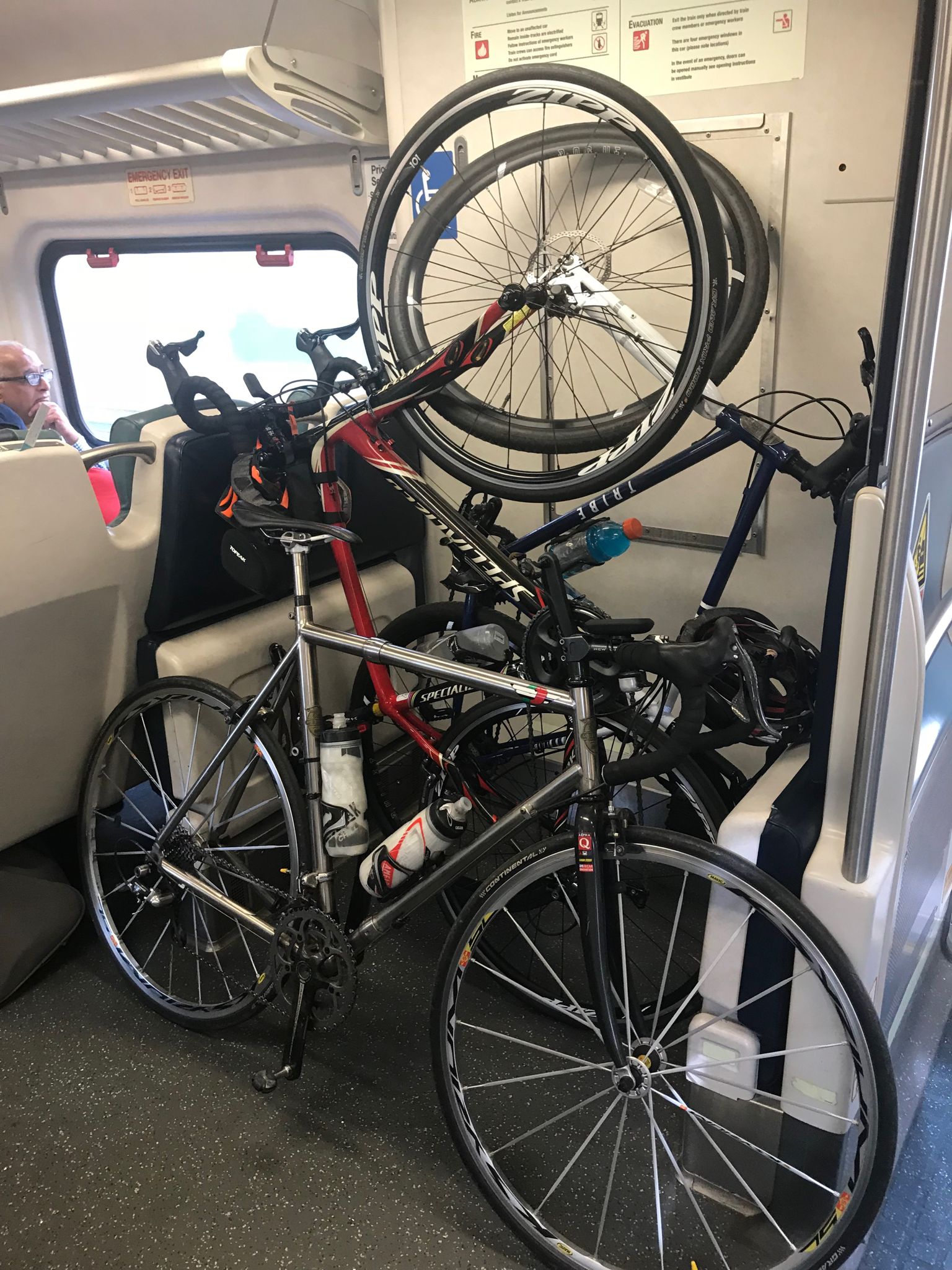
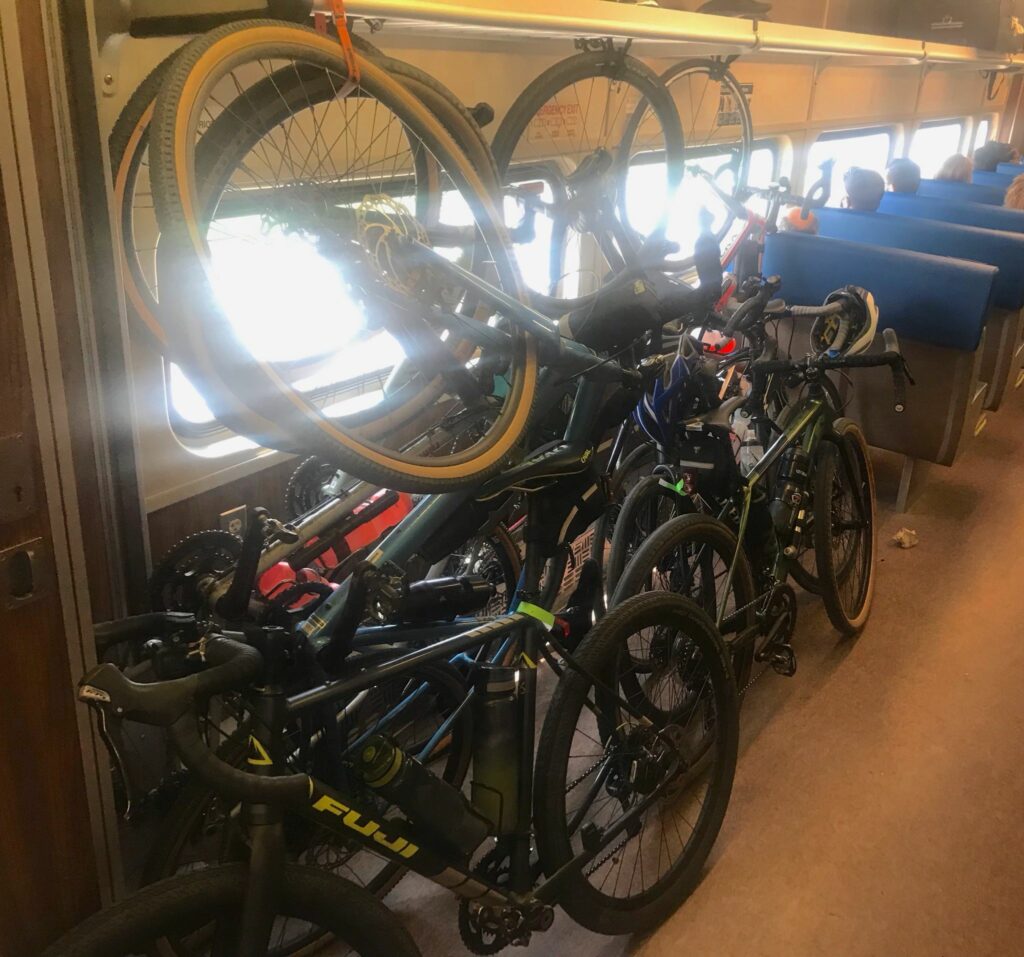
– There are two types of handicapped areas on MNR trains. On older trains it tends to be a long space across from the bathroom. On newer trains it’s smaller spaces with fold-down seats. I’ve put pictures of each below.

– On the older trains with the long space (see below) people tend to just lean their bikes up against the side, but you can fit more bikes in if everyone hangs their front wheel off the rack above the space. I carry a length of velcro for this purpose, but you can also use the straps of your helmet – put your helmet on the rack above and then clip the helmet straps through your front wheel. Even if you lean your bike against the side velcro is handy to stop your bike rolling forward and back – just velcro a wheel to the some part of the frame. The picture below shows bikes both hanging and just leaning against the side.

– On the newer trains (see top pic) it’s best if you basically flip your bike upside down and put the handlebars against the seat or partition. The smallest bike should go in first, and then you alternate sides with subsequent bikes. You can fit 3-4 bikes on the 3 seat side of the train and 2-3 on the 2 seat side of the train if you do that. If you just “park” your bike in the space you can only fit 1 or 2 bikes on each side before they start obstructing the aisle. The top picture shows two bikes stacked that way and another just leaning up against them.

– When there are a lot of bikes and not many passengers the conductor might tell you to hang your bike in the seats. It’s the same idea as hanging it in the wheelchair area – you hang the front wheel off the rack above. Pick seats on the 2 seat side of the train.

– And lastly – it’s not hard for bikes to get damaged on the train – so wherever you put your bike – make sure if there’s some movement that there won’t be damage.